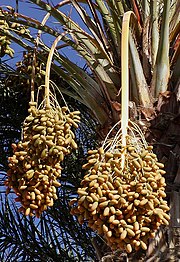
 The Date Palm (Phoenix dactylifera) is a palm in the genus Phoenix, extensively cultivated for its edible fruit. Due to its long history of cultivation for fruit, its exact native distribution is unknown, but probably originated somewhere in the desert oases of northern Africa, and perhaps also southwest Asia. It is a medium-sized tree, 15–25 m tall, often clumped with several trunks from a single root system, but often growing singly as well. The leaves are pinnate, 3–5 m long, with spines on the petiole and about 150 leaflets; the leaflets are 30 cm long and 2 cm broad. The full span of the crown ranges from 6–10 m.
The fruit is a drupe known as a date. They are oval-cylindrical, 3–7 cm long, and 2–3 cm diameter, and when unripe, range from bright red to bright yellow in colour, depending on variety. Dates contain a single seed about 2–2.5 cm long and 6–8 mm thick. Three main cultivar groups of date exist; soft (e.g. 'Barhee', 'Halawy', 'Khadrawy', 'Medjool'), semi-dry (e.g. 'Dayri', 'Deglet Noor', 'Zahidi'), and dry (e.g. 'Thoory'). The type of fruit depends on the glucose, fructose and sucrose content.
The Date Palm is dioecious, having separate male and female plants. They can be easily grown from seed, but only 50% of seedlings will be female and hence fruit bearing, and dates from seedling plants are often smaller and of poorer quality. Most commercial plantations thus use cuttings of heavily cropping cultivars, mainly 'Medjool' as this cultivar produces particularly high yields of large, sweet fruit. Plants grown from cuttings will fruit 2–3 years earlier than seedling plants.
Dates are naturally wind pollinated but in both traditional oasis horticulture and in the modern commercial orchards they are entirely pollinated manually. Natural pollination occurs with about an equal number of male and female plants. However, with assistance, one male can pollenize up to 100 females.
